
Share This Article
Near downtown Houston, Buffalo Bayou flows through a narrow corridor surrounded by buildings, bridges, trails, and parks. Just upstream, White Oak Bayou joins Buffalo Bayou at their confluence at Allen’s Landing. Because there is not enough open land for wide, sloped banks, the Harris County Flood Control District uses steel sheet pile walls to hold the sides of the bayous in place almost vertically, allowing more stormwater to flow through downtown.
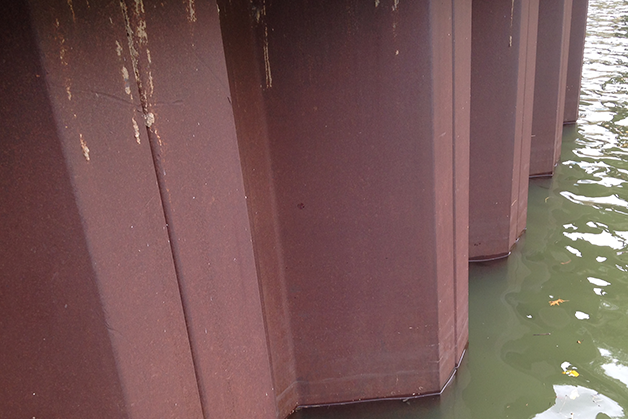
These steel walls have been underwater for more than 30 years. When metal is in water, it naturally starts to corrode. To prevent this, the Flood Control District uses a system called “cathodic protection” that works like a shield for the steel.
What is Cathodic Protection?
Corrosion occurs when metal loses tiny particles called electrons. In this system, special metal rods called anodes are placed near the steel walls.
A small electric control panel sends a gentle current that drives electrons from the anodes to the steel wall. This keeps the wall from losing its own electrons, which helps prevent corrosion.
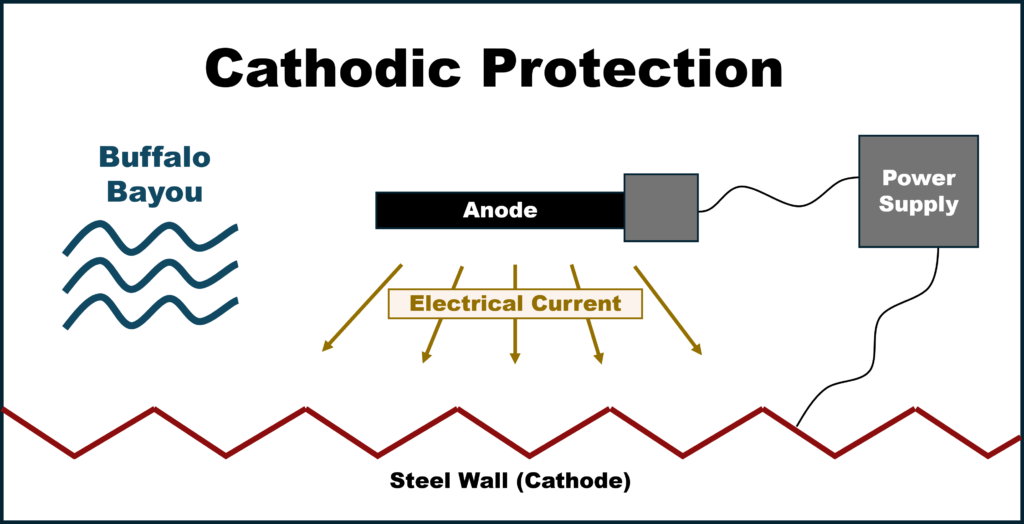
The Flood Control District tests these electrical currents along the walls to make sure everything is working. Divers sometimes take measurements underwater to check for spots where the protection is not working as well as it should. Recent tests near Sesquicentennial Park showed some parts of the walls are not receiving enough electrical current, matching earlier surveys showing certain sections were not fully protected and might have small breaks in the electrical path.
To fix the problem and give the walls increased protection again, Flood Control District engineers are planning several important upgrades. They will install new and possibly larger anode beds, improve the electrical connections, and add or replace the equipment sending the protective current to the steel walls. Divers will also repair some of the underwater sections of the wall. These upgrades will restore the system to its original strength and reliability.

If the walls corrode too much, they could weaken, and repairs would become harder and more expensive. The Flood Control District’s maintenance of these steel walls helps preserve public spaces and ensures the longevity of investments in our drainage network. You can learn more about the Flood Control District’s maintenance work at www.hcfcd.org/maintenance, and stay informed by following us on social media.