

Share This Article
Every day, the Harris County Flood Control District works to reduce flood risk for communities across Harris County. One important way we do that is by creating space for stormwater to go during heavy rain.
That’s exactly what the Yale Stormwater Detention Basin project is designed to do. It will improve stormwater management and help support long-term flood mitigation efforts along Little White Oak Bayou.
Why this project matters
Stormwater detention basins help reduce flooding by temporarily holding excess rainwater during intense storms and then slowly releasing it back into the drainage system once water levels begin to drop. This helps reduce pressure on nearby channels and stormwater infrastructure during heavy rainfall.
The Yale Stormwater Detention Basin was identified through a feasibility study of the Little White Oak Bayou subwatershed conducted after Hurricane Harvey, and it is expected to play a key role in supporting future channel conveyance improvements along Little White Oak Bayou.
Where is it?
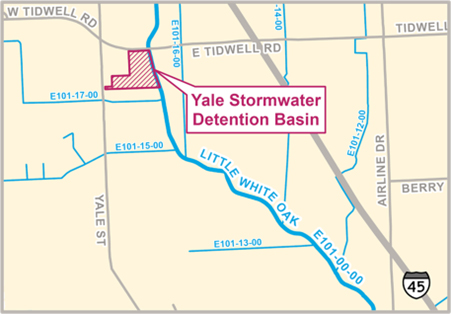
The project footprint covers about six acres and sits in north central Harris County, near the Northside of Houston, at the corner of Yale Street and West Tidwell Road.
What will it do?
Once complete, the stormwater detention basin will be able to store about 72 acre-feet of stormwater during heavy rain events. To put that into perspective, that’s equivalent to about 72 football fields covered in one foot of water.
That kind of storage can make a real difference when storms hit. They help reduce flooding in the area by holding stormwater temporarily and releasing it as stormwaters recede.
Project timeline
Construction began in February 2025 and is expected to wrap up in the first part of 2026. More information will be shared when it’s completed!
A closer look: protecting the slopes
As construction progresses, you’ll notice reinforced anchored mat along the side slopes of the basin. This system combines turf reinforcement mats and engineered earth anchors to provide strong erosion control and slope stabilization. It also supports vegetation growth along the basin’s slopes, making it a durable solution that’s also environmentally friendly.
The Flood Control District remains focused on advancing flood risk reduction and maintenance efforts that deliver lasting benefits across Harris County. By moving projects efficiently from planning to construction, the Flood Control District continues to strengthen resilience today and into the future. Stay informed by following us on social media.